
 English
 Spanish
 Russian
 Arabic
 Italian


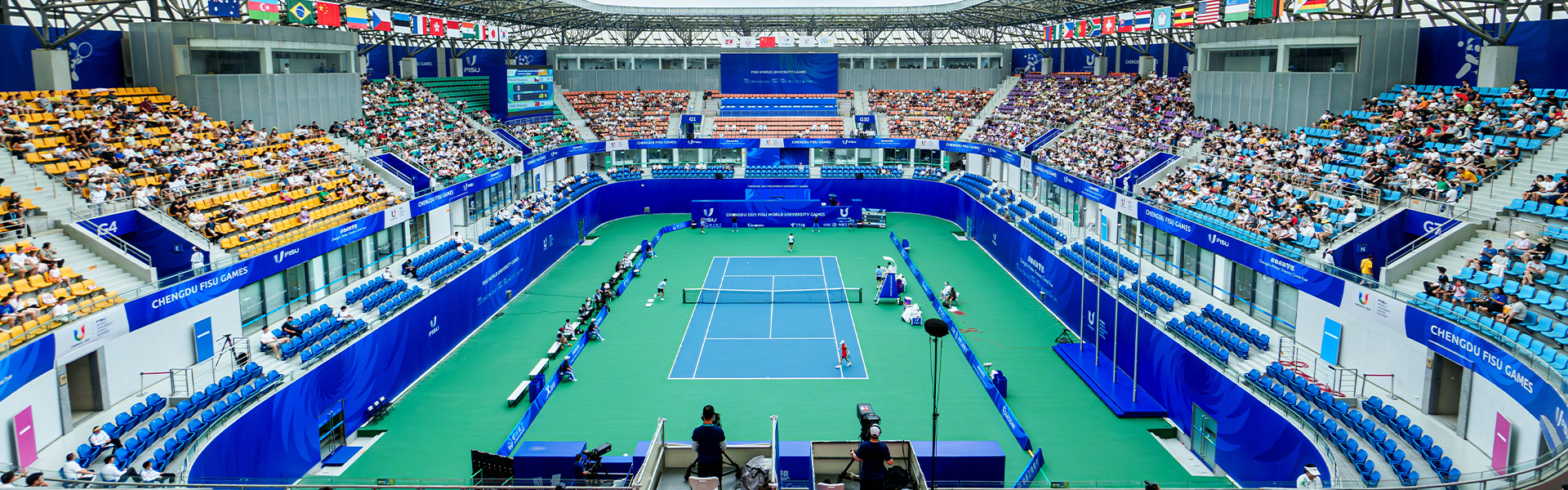
"Illuminance" in Sports Lighting: It's Not About Being as Bright as Possible, But About Precisely Meeting Standards.
Illuminance refers to the amount of light received per unit area, measured in lux. In sports lighting, it directly determines whether athletes can clearly see the ball, whether referees can make accurate calls, and whether TV broadcasting are sufficiently clear.
Sports Lighting Illuminance Levels
Illuminance requirements vary drastically across different sports scenarios. A community basketball court may require only 300lux, whereas a stadium hosting televised matches must achieve levels exceeding 1400lux while simultaneously meeting a comprehensive set of metrics—including vertical illuminance, uniformity, and glare control.
According to *JGJ153-2016 Standard for Lighting Design and Measurement of Sports Venues*, sports venue lighting is classified into six levels based on functional use:
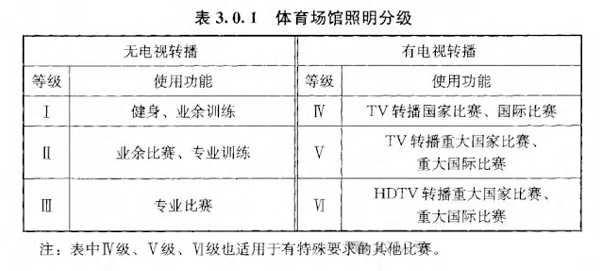
Level II: Amateur Competitions and Professional Training — Horizontal Illuminance: 500 Lux
Level III: Professional Competitions — Horizontal Illuminance: 1000 Lux
Level IV: TV Broadcasting of National and International Competitions — Vertical Illuminance at Main Camera Position: 1000 Lux
Level V: TV Broadcasting of Major National and International Competitions — Vertical Illuminance at Main Camera Position: 1400 Lux
Level VI: HDTV Broadcasting of Major National and International Competitions — Vertical Illuminance at Main Camera Position: 2000 Lux
Court Illumination Must Be "Just Right"
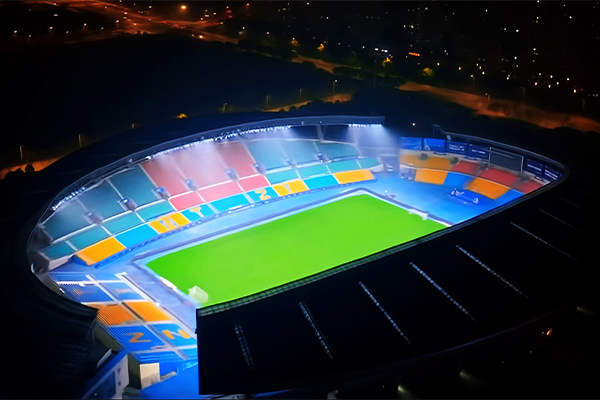
For the Jiangsu Rugao Olympic Sports Center project, SCL designed the lighting system in accordance with the National Standard Level V classification (designated for TV broadcasting of major national competitions), utilizing 270 sets of 1500W professional stadium lights. Measured data indicates an average illuminance of 2131lux, with uniformity values U1 and U2 reaching 0.90 and 0.78, respectively.
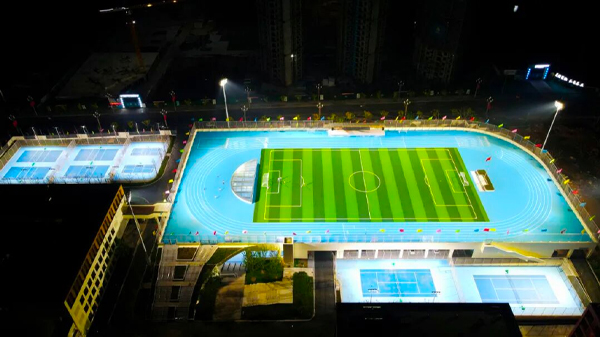
The athletics track at the Tsinghua University High School (Tianfu Campus) is equipped with 15 sets of 1000W stadium lights from SCL; the football field achieves an average horizontal illuminance of 577lux, while the athletics track maintains an average horizontal illuminance of 569lux.
More Important Than "Brightness": Illuminance Uniformity
Professional sports lighting is not simply a matter of "the brighter, the better"; rather, it requires a site-specific approach to achieve precise compliance. It must not only satisfy illuminance requirements but also ensure uniformity and effectively control glare. Meeting illuminance standards is merely the first step; if light distribution is uneven—resulting in a playing field characterized by alternating bright and dark patches—it will inevitably compromise athletic performance.
Illuminance uniformity is measured using U1 (the ratio of minimum illuminance to maximum illuminance) and U2 (the ratio of minimum illuminance to average illuminance). The closer these values are to 1, the more uniform the lighting.
Why is uniformity so critical? Take basketball as an example: when an athlete drives from beyond the three-point line to the basket, if the visual environment flickers between bright and dim, their pupils must constantly adjust. This not only leads to eye fatigue but can also negatively impact shooting accuracy. The essence of professional lighting design is to ensure that every single inch of the court enjoys the exact same quality of light.
How to Assess and Improve the Lighting Environment of a Venue
1. Professional Testing: Illuminance Meter Measurement (Grid Point Method)
According to JGJ153-2016, illuminance measurements must be conducted by establishing a grid layout based on the "center-point method." An illuminance meter is placed at the center of each grid cell to record readings point-by-point, after which the average illuminance, U1, and U2 values are calculated. Upon the completion of every project, SCL performs these field measurements; final acceptance is granted only after verifying that the data meets the required standards.
2. Construction and Commissioning: Precisely Adjusting Every Light Fixture
Achieving uniform illuminance is inextricably linked to the precise installation of the lighting fixtures. The Qidazhou technical team utilizes laser rangefinders for positioning, strictly adjusting the angle of each fixture in accordance with the lighting layout and projection diagrams specified in the design blueprints. The dual-axis adjustable brackets feature calibrated scales, allowing for absolutely no deviation—not even by a single degree. Upon completion of the calibration process, a final verification is conducted from the athletes' perspective to ensure the complete absence of glare or dark zones.
3. Design Solution: Scientific Lighting Layout + Precise Light Distribution
The foundation of lighting uniformity lies in the design phase. Qidazhou utilizes AGI32 software to conduct illuminance simulations; based on the venue's mounting heights, catwalk locations, and luminaire photometric distribution curves, we iteratively optimize the quantity, wattage, and layout of the fixtures, ensuring that the theoretical calculated values meet the required standards before construction commences.
As one of the drafting units for the national standards *Technical Requirements for LED Sports Lighting Applications* and *Design Standards for Outdoor Worksite Lighting*, SCL consistently upholds a commitment to underpinning every design proposal with professional expertise and scientific data. From major events such as the World University Games and the National Games to campus sports centers and community courts—we provide the world with healthy and comfortable lighting environments for sports, powered by our uniquely crafted LED sports lighting products.

 Service Hotline:
 Email:
 Add:
Add: